Even when we open any particular blog
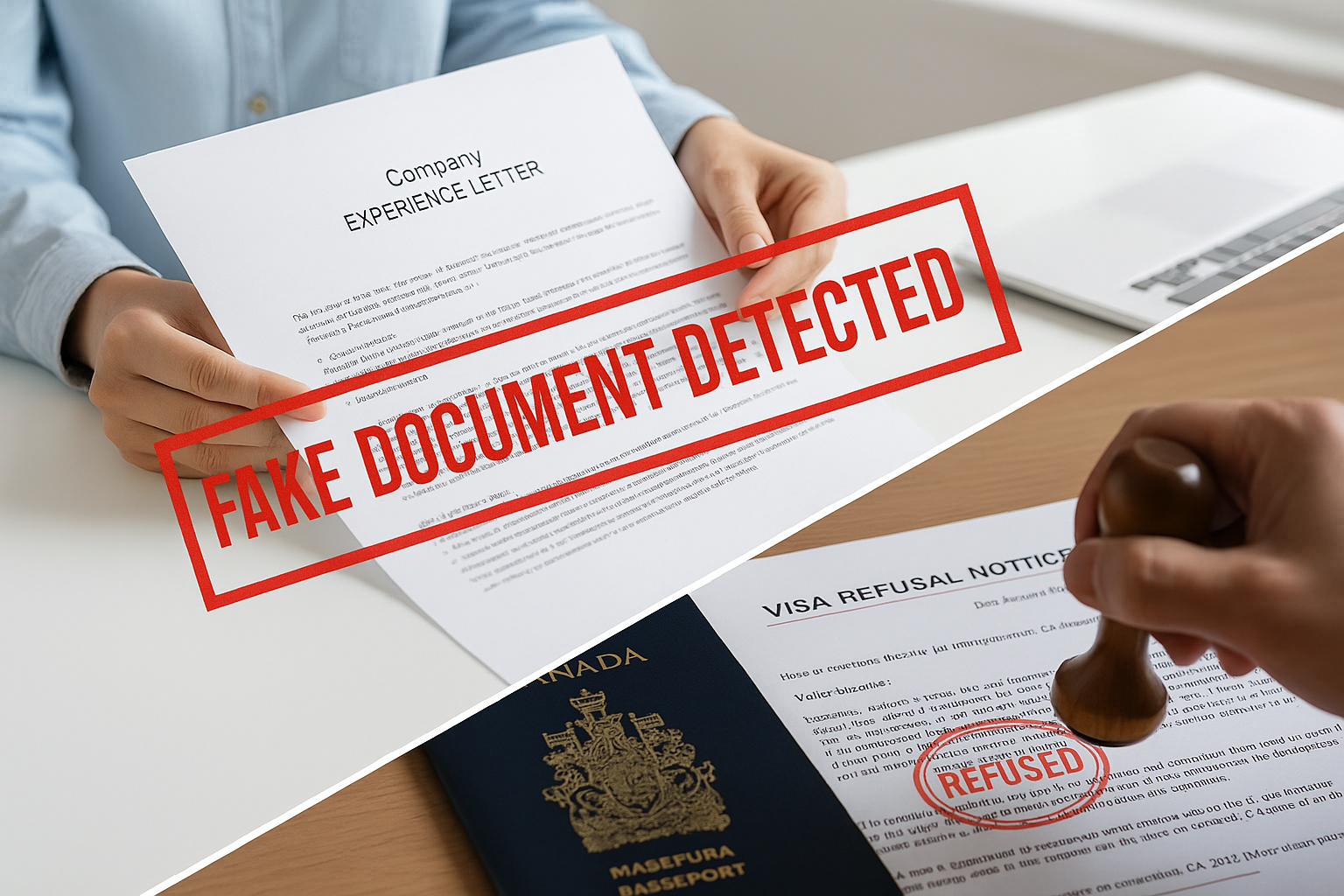
Using a fake or altered experience letter is one of the fastest ways to get your immigration or work/study visa refused — sometimes with long-term bans. This post explains how fake experience letters trigger refusals, what visa officers look for, the serious consequences, and practical steps to avoid problems and recover from past mistakes.
Experience letters are used to verify:
Your job title and duties (match to NOC / occupation codes),
Employment dates (start/end),
Employer contact details, and
Salary / role seniority — all of which affect eligibility for work permits, LMIA, skilled immigration, and credibility in general.
Immigration officers use experience letters to check whether the applicant actually has the skills, responsibility, and genuineness claimed in the application. Any mismatch or doubt → credibility questioned → refusal.
Inconsistent dates across resume, payslips, EPF/CPF, and letter.
Generic wording (no company letterhead, no signatory name or position).
Wrong or unverifiable company contact details (fake email domains, wrong phone numbers).
Mismatch with payroll/tax documents (salary shown in letter doesn’t match tax returns/pay slips).
Letter formatting errors (poor grammar, odd fonts, or scanned alterations).
No independent verification — officer calls the employer and gets no response or a denial.
Multiple applicants using identical letter templates from the same company.
The employer refuses to confirm when contacted or says the person never worked there.
Misrepresentation rules: Giving false information is considered misrepresentation under immigration law. That’s a severe ground for refusal and can result in bans (often 1–5 years depending on country/immigration rules).
Credibility erosion: Even unrelated parts of your application (financials, relationship genuineness, SOP) get doubted if the employment portion is false.
Chain reaction: If a core eligibility requirement depends on the experience (e.g., skilled worker points, LMIA, or employer-specific job offers), the entire application can be invalid.
Immediate refusal of the visa application.
Inadmissibility / misrepresentation ban — many immigration authorities impose bans (hard to overturn).
Difficulty in future applications — subsequent applications get heightened scrutiny.
Reputational risk with employers and third-party consultants.
Criminal exposure in some jurisdictions if fraud is serious (rare, but possible).
Use only genuine employment letters on company letterhead with: company registration number, address, official email, signatory name + designation, and signed/dated.
Attach supporting documents: payslips, bank salary credits, tax returns (ITR/T4/ROE), appointment/offer letter, relieving letter, and attendance records.
Ensure consistency: job title, responsibilities, dates, and salary must match across all documents.
Provide a detailed job duties list in the letter that matches NOC/occupation codes (or equivalent).
If your previous employer is small/unregistered, include extra proof: contracts, invoices, client references, project reports, or supervisor affidavits.
Keep employer contact details updated and include verifiable phone & email addresses.
If you had gaps or short-term contracts, attach explanatory LoE and supporting evidence (freelance invoices, contract copies).
Be transparent about outsourced roles/consultants — clarify the organizational structure rather than hiding it.
Don’t hide it. If you receive a refusal and it’s due to misrepresentation, consult immigration counsel immediately.
Prepare a full explanation (LoE) detailing why the discrepancy occurred (truthful, clear, and supported by documents).
Collect genuine supporting evidence: payslips, tax records, client testimonials, bank statements showing salary credits, appointment/offer/release letters.
Reapply carefully after correcting documents and explaining past issues — sometimes with a new LoE and third-party verification.
Consider legal appeal or judicial review only when there’s a strong factual or procedural error in the refusal.
Use accredited consultants to audit your file before reapplication — avoid shortcuts.
Applicant A submitted a letter claiming managerial duties but tax records showed a lower job grade → officer suspected fabrication → refused.
Applicant B provided genuine join/leave dates but no payslips; officer couldn’t verify salary → asked for more proof; applicant supplied bank statements and got approved.
Applicant C used a template letter bought online; employer denied issuing it when called → misrepresentation and a 2-year ban.
Document audit: We check every employment letter, payslip, and tax record for inconsistencies.
Employer verification: We advise how to get correct contact details and verification letters from previous employers.
Statement of Purpose & LoE drafting: Strong, honest explanations that pre-empt IR queries.
Reapplication & refusal strategy: If you were refused, we create a tailored refile plan (evidence compilation, LoE, appeal guidance).
Ethical guidance: We never recommend fake documents — we build legitimate pathways (education, short courses, bridging work experience) if you lack required experience.
Do:
Use genuine letters + multiple supporting proofs.
Be consistent across documents.
Declare past refusals honestly.
Don’t:
Use purchased or templated fake letters.
Expect to hide discrepancies.
Ignore officer queries — respond with evidence.
Fraudulent shortcuts cost far more than honest preparation. Visa officers are trained to detect inconsistencies; a small fake letter can ruin years of planning. The safer path is to build a transparent, well-documented file — and, if needed, get help from trusted consultants who work ethically.
If you’re unsure about any employment proof or have a past refusal, Macro Global & GD Immigration can review your file and give a clear action plan to move forward the right way.
Need a file audit or help with a refusal? Contact Macro Global / GD Immigration for a confidential evaluation and practical next steps.
Macro Global (India)
Offices: Moga | Jagraon | Mullanpur | Ludhiana
Call: 87250-20904 | 98158-20904
GD Immigration (Canada)
Location: Brampton, Ontario
Call: +1 (437)-245-2828
Visit: www.gurmilapsinghdalla.com


 +91 87250 20904
 204-891-5005